For producers, artistic directors and selection committees
About the show
How is this different from the Christmas shows we have done before?
It is an original full length play rather than another adaptation of a title your audience already knows. It is also staged differently. The audience is the studio audience for a live 1950s radio broadcast, so they are inside the show rather than watching it. They are spoken to, sung with, and their children come up on stage in the second act.
How long is the show?
About two hours in two acts, with one intermission.
Is it appropriate for all ages?
Yes, absolutely. There is no profanity and no adult themes. The great-grandfather the children talk about has passed away, though the show never states it outright. He is present in the story as a warm memory rather than as a loss.
Is this a religious show?
Not overtly, though it is a Christmas show. The focus is family, and the memories, fun, excitement and traditions of Christmas. The O Holy Night and Silent Night sequence is more reverent in tone.
Who wrote it?
The author is a retired wedding and radio DJ with a lifelong love of music, who was in theater in high school and has wanted to get back on stage ever since. The premise of the show came to him in a dream. Much of what happens on stage is drawn from his own life. The scene about sneaking downstairs the night before Christmas morning is his own, and the forgotten song was his grandfather’s favorite, performed on stage with exactly the ritual his grandfather repeated every single year. The narrator is named after his grandmother, and the station’s call letters, WMRG, are his grandparents’ initials. This is his first completed script, with more to come. There is a fuller biography on the licensing page.
Can our community be part of the show?
That is how it is built. Guest performers are cast by open audition from the community and can change from performance to performance, and there is a school choir spot in each act. Most of the people on stage are the audience’s own neighbors. That is also why it works as a community fundraiser.
Staging and production
How large a cast do we need?
Four principals, an early-teen lead, and four to six non-speaking children roughly ages five to ten. Most song performances are featured guest spots, which you can cast from your own roster or fill by open audition with recognizable local names, plus an optional school choir spot in each act.
Do we need a live band or an orchestra?
No. Every number is performed to professionally produced, period-correct backing tracks. There is no pit and no musicians to hire.
How much rehearsal time does the show require?
One full-cast rehearsal plus a tech and dress rehearsal on stage. The radio side and the attic side never interact, so they rehearse separately, and guest performers rehearse on their own time and attend only those two. A full run-through without guest performers takes about 45 minutes.
What are the technical requirements?
Light. Two fixed playing areas, no fly system, no scene changes, no blackouts, and a relatively simple lighting plot. Three body-worn mics if you have them, with workable alternatives if you do not. Backing tracks, pre-recorded commercials and a detailed cue sheet are provided. Almost the entire cast enters at the very start, at the same time, and stays on stage for the whole show. Guest performers enter and exit from the side, but they do not need to be hidden beforehand, and one child leaves the stage for about fifteen seconds. Wing space is barely a consideration.
What set do we need to build?
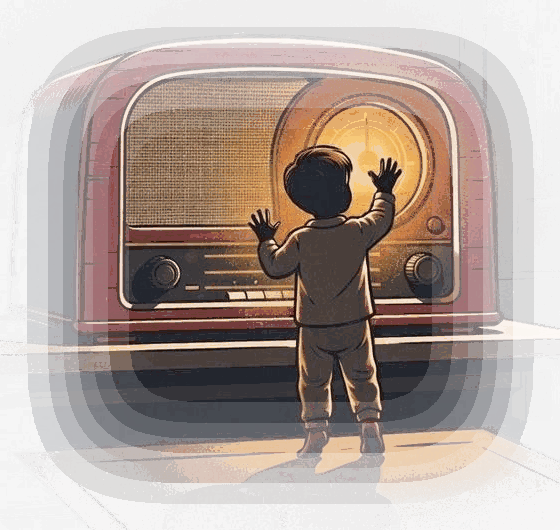
Most theaters will already have the majority of these pieces in a storage closet. Stage right is the radio station: two podiums with vintage mics, a performance area, a bandstand, and five cardboard person cutouts, where homemade is fine and preferred. Stage left is an attic: old trunks and suitcases, a mattress, an armchair, and a larger than life vintage radio with a lit dial. That radio can be built from cardboard or wood, a piece of clear plexiglass and a lightbulb.
What are the wardrobe requirements?
Simple, and mostly things people already own. On the radio side, the hosts wear 1950s style formalwear, meaning a tuxedo and an evening gown. The floor manager wears black pants, a black button-up shirt and suspenders, with a period-correct hat if you have one. On the attic side, the children wear present-day everyday clothes, or holiday-themed onesies, which are preferred. The narrator wears dress casual, nothing flashy. Guest performers wear period-correct formalwear, along the lines of a holiday ball.
Can we perform it in a church sanctuary, a gym, or a non-traditional space?
A school auditorium, a theater or a church sanctuary works, with 200 seats or more. A gym or other non-traditional room does not, and the reason is sound. A gym cannot carry dialogue and music to an audience, and this show depends on both being heard. What your venue needs is a sound system that covers the room and someone who knows how to run it, and that person usually comes with the room.
Is it suitable for a church or a school?
Yes to both. The script can also be adapted so the entire show is cast with young people, and a couple of middle schoolers playing 1950s radio hosts is a genuinely charming prospect. The one role that needs an adult is the Narrator, who should be fifty or older, for reasons that become clear when you read the script.
What if we have never produced a musical before?
Then this is the show for you. It was written and conceived as a very simple production with a very large payoff. There is not much dialogue or monologue to learn, the songs are ones everyone already knows, and the whole show can be rehearsed start to finish in about 45 minutes when the guest performances are skipped. There is no pit, no musicians to coordinate and no scene changes to run. A detailed cue sheet is provided, and the author is available to consult. If you would rather not do it alone, the show can also be booked as a turnkey fundraiser with the author producing and directing.
Can we change the song list?
No. Each song is introduced by name, in its own written introduction with its own joke, so swapping a song would mean rewriting the script around it. The song list is part of the show.
Can we change the script?
As with any licensed production, unauthorized script changes are strictly forbidden. The show must be performed word-for-word. If there’s a line or two that you’d like to customize, remove, add, or change, please contact us and we’ll review.
Do you provide marketing materials?
Yes. You receive a print-ready PDF that you can edit to include your own location and dates. A booked production also comes with a full Production Playbook covering sponsorship, ticketing and a complete marketing plan.
Can we record or livestream the performance?
No livestream, and no posting online anywhere. You may make a single-camera recording on a tripod for distribution to your cast and crew only. This is not a preference, it is a condition of the music licensing.
Licensing, fees and dates
How much does it cost to license Christmas on the Dial?
A $100 script fee, which includes up to two hours of consulting with the author, plus $195 per performance. Discounts are available for fundraising performances benefiting local charities, for all-volunteer companies, and for five or more performances. Full terms are on the licensing page. Those discounts apply to licensing. A booked production is priced separately and is not discounted further, because the production fee already assumes a nonprofit.
Do we have to license the music separately?
Partly. Backing tracks come from a separate company at roughly $30 per performance. Your venue’s existing ASCAP or BMI license covers performing the songs. The original music written for the show, including the pre-show songs, the commercials and the underscore for Twas the Night Before Christmas, is all included at no extra cost.
When are fees and royalties due?
For licensing, the script fee is due at order and full performance royalties are due 30 days before opening. If your run is held over, payment for the additional performances must be made before those performances take place. For a booked production, a $500 non-refundable retainer reserves your dates, followed by half the guarantee, the script fee and 50 percent of your performance fees three months before opening, the rest 30 days before opening, and anything above the guarantee within 14 days after your final performance. What it costs sets out the whole schedule.
How many performances can we schedule?
As many as you like. Fees are charged per performance, and discounts are available if you are performing it five or more times.
Is there a preview or student performance option?
Yes. With three or more paid performances you may add one free performance on the afternoon before your official opening. It is limited to local school children and local media, and it is not promoted to the general public.
What happens if we have to cancel?
For licensing, the $100 script fee is not refundable. Performance fees are waived if you cancel 30 or more days before your planned opening, and refunded in full if no performances have taken place. If you cancel partway through a run, fees for performances already given are not refunded. For a booked production, the $500 retainer that reserves your dates is not refundable.
How far ahead should we book?
Six to nine months is preferred. Dates are reserved first come, first served, and there are only four or five usable weekends between the week before Thanksgiving and Christmas, so earlier is genuinely better.
Can we read the script before deciding?
Yes. A perusal script is available on request, and the author is happy to answer questions by email before you commit.